
This post may contain affiliate links, including those from Amazon Associates. If you make a purchase through these links, I may earn a commission at no additional cost to you. Learn more about our affiliate policy.
My first ever studio apartment was one room that had to hold everything, sleeping, working, resting, and untangling from the day.
There was no door to close between the version of me answering emails and the version of me that needed to lie down and just breathe.
I learned that privacy in a small home isn’t about square footage. It’s about the signals a space sends your body when you cross from one part of it into another.
This post gathers what actually worked, the kind of small studio apartment ideas that create real separation without a wall between rooms.
A Few Ways to Section Off Your Space
Here’s what you’ll find below:
- Why curtains create instant, real separation
- How a bookshelf works better than a wall
- Where a folding screen fits in between
- Facing furniture away to mark invisible edges
- Managing sound so privacy holds under pressure
- Using light to signal where each zone begins
- What to try first if this feels like a lot
The First Divider Idea Worth Trying
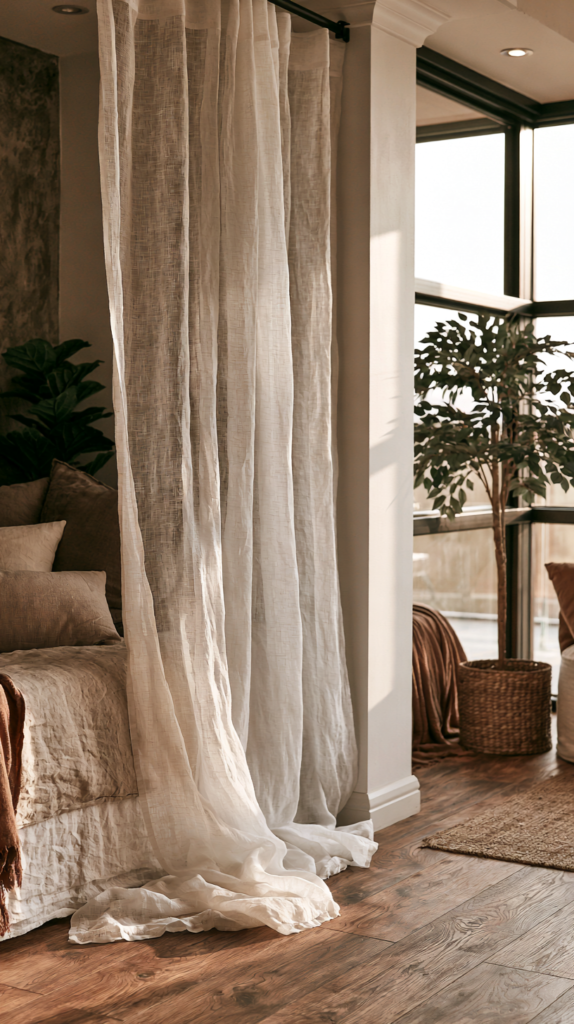
A curtain sounds almost too simple to matter, but your nervous system doesn’t need permanence to register a boundary. It needs a visual cue that says this part of the room is different from that part.
A ceiling-mounted track or a tension rod placed just past your bed frame gives you a closeable edge in under an hour, with no landlord approval and no holes in the wall.
Consider a few placement options depending on your layout:
- A track that wraps around the bed on three sides for full enclosure
- A single panel hung between the sleeping area and the main room
- A sheer fabric if you want the boundary without losing daylight
- A heavier, lined curtain if sound and light both need blocking
A sheer panel keeps the room from feeling divided when it’s pulled open, which matters when your square footage is already tight.
The goal isn’t to hide the bed. It’s to give your eyes somewhere to stop.
Let a Bookshelf Be the Wall You Don’t Have
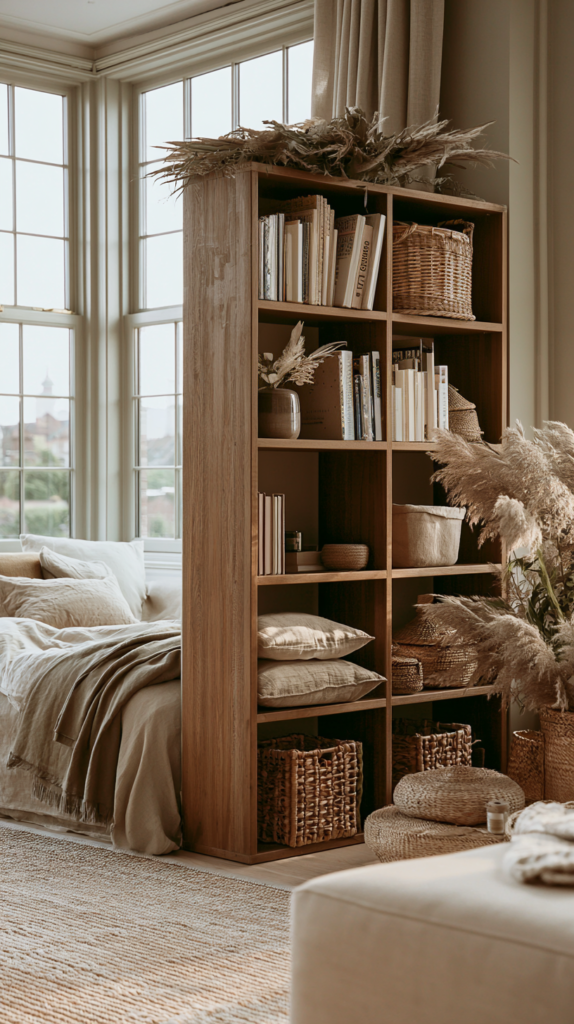
Open shelving does something a curtain can’t. It holds your things while it holds the line between spaces.
A tall shelf positioned perpendicular to the wall, roughly waist to shoulder height, breaks sightlines without swallowing the light that makes a small apartment feel larger than it is.
If you want more visual and sound separation, choose a shelf with a few closed cubbies at the bottom and open shelving above. If light and airflow matter more to you, keep it fully open and use woven baskets to soften what’s visible from either side.
This is one of my favorite low-cost edits because the furniture is already doing a job. It just needs to be turned sideways.
A Folding Screen Can Do the Job of a Door
If a curtain feels like too faint an edge and a bookshelf feels too permanent, a folding screen sits right in the middle.
It closes fully when you want the sleeping area out of sight, and it collapses flat against a wall the moment you don’t. Renters tend to reach for this option first because nothing about it touches the walls or the floor.
A few materials worth considering, depending on what your room needs most:
- A woven rattan screen if you want warmth and texture without full opacity
- A solid wood or painted panel screen for complete visual privacy
- A frosted acrylic or fluted glass screen if you still want light to pass through
- A tall fabric-paneled screen if you want something calming to look at from either side
None of these require a single tool. A boundary you can fold away in thirty seconds is still a real boundary while it’s standing.
Turn Furniture Into a Boundary Without Buying Anything New
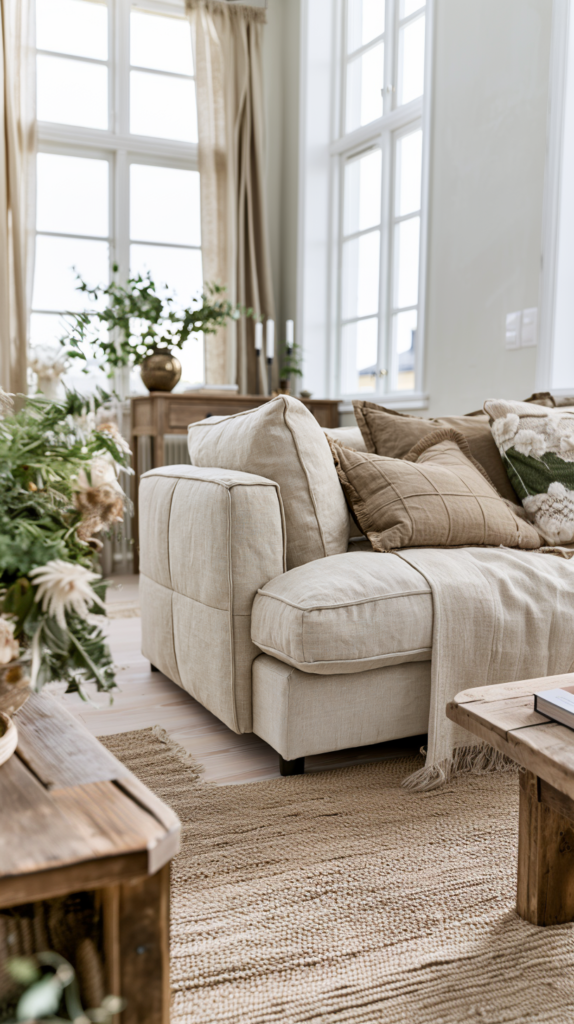
Where a couch or chair faces makes as much of a boundary as what stands between two zones.
Try repositioning what you already own before you shop for dividers:
- Angle your sofa so its back faces the sleeping or working area
- Pull your bed frame away from the main walkway through the room
- Use a console table behind the sofa to create a shallow, in-between zone
- Group your reading chair and a small lamp into their own corner
A room stops feeling like one long stretch of shared space the moment its furniture stops facing every direction at once.
Your body settles when there’s a clear edge to rest against, even if that edge is just the back of a couch.
Sound Is Part of Privacy Too
Visual separation solves half the problem. The other half is what you hear from across the room.
Soft, upholstered surfaces (a couch, a rug, a stack of pillows) absorb sound in a way that hard floors and bare walls never will. A bookshelf filled with books against a shared wall works almost as well as a moving blanket, and it looks a great deal better.
A few low-effort additions that settle a shared room:
- A thick area rug under the bed or sitting area
- Heavier curtains that double as sound dampeners
- A fabric headboard instead of a wooden one
- Weatherstripping along a shared door if you have one
If you’re working to turn your apartment into a nervous system sanctuary, sound is often the piece that gets overlooked first. It’s harder to point to than a visible wall, but your body registers it just as clearly.
Let Light Mark the Edges Your Walls Don’t
Lighting is the fastest way to tell your nervous system which zone you’re in without a single physical divider.
Assign each zone its own light source if you can:
- A warm, low bulb near the bed for winding down
- A brighter, cooler lamp at a desk or reading chair
- A plug-in dimmer so the whole room can shift together in the evening
When the switch for your sleeping corner is separate from the switch for the rest of the room, your body learns the difference between the two spaces faster than your eyes do. That small delay, reaching for a different lamp, is often what tells your brain a shift is happening.
What to Try First If This Feels Like a Lot
You don’t need to do all of this at once, and you don’t need a renovation budget to feel a difference.
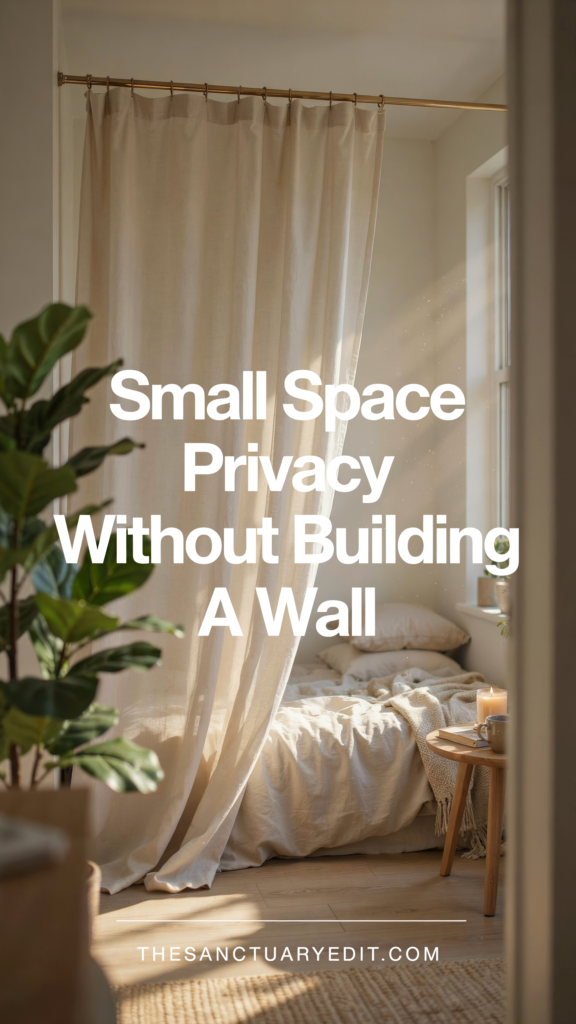
If you only make one change, hang the curtain. It’s reversible, it’s inexpensive, and it gives your body an immediate visual cue that one part of the room belongs to rest.
Everything past that first edit is optional layering. Even a studio can feel airy and peaceful once the zones inside it are clear, and that clarity tends to build on itself once you start.
Closing Reflection
None of this requires more square footage or a different apartment. It asks for a few honest edits: a curtain here, a shelf turned sideways there, furniture angled toward its own small corner.
Once your body can feel where one part of the day ends and another begins, even one room becomes a place to fully arrive in. A gentle boundary is still a boundary, and your home is allowed to hold you exactly as it is right now.

